

AIUC-1 Consortium
The AIUC-1 standard is developed and maintained with the AIUC-1 Consortium, uniting 300+ security & risk leaders across the Fortune 500. The standard is updated quarterly following the process described below. The process is designed on the following principles:- Broad input: All consortium members can propose changes to AIUC-1 each quarter. The input shapes quarterly release priorities alongside changes to legislation, new incidents, and new agent capabilities.
- Focused updating: AIUC Standards team collect inputs and translate them into formal standard changes. For some changes, smaller working groups are created to work through proposed changes in a targeted way.
- Transparent review: All proposed standard changes go through a transparent peer-review, enabling consortium members to question and challenge proposed updates. AIUC Standards team finalize standard changes based on peer-review feedback before final release. All changes are documented in a public changelog.
AIUC-1 Certification
To earn AIUC-1 Certification, organizations must submit to a control audit by an accredited auditor and submit agents to technical evaluations:- Accredited auditors validate that organizations have implemented effective controls to meet all applicable AIUC-1 requirements. The auditor writes the AIUC-1 audit report and issues a recommendation to certify.
- Technical evaluations validate how agents behave against real world risk. Results are included in the audit report, graded by severity. To pass AIUC-1 Certification, organizations must demonstrate no Critical (P0) or Major (P1) findings. Evaluations are currently conducted only by AIUC, to ensure consistent quality and methodology across certified agents.
- Risk taxonomy - a comprehensive taxonomy of agent risk areas by category
- Attack taxonomy - an overview of benign and adversarial tactics to elicit risks
- Incident database - a sample of real-world incidents used to ensure evals are realistic
Accrediting technical evaluators
Accrediting technical evaluators
Accreditation criteria for technical evaluators are being developed in parallel with the pilot. To earn accreditation, technical evaluators must demonstrate the ability to consistently and at a high quality:
- Scope evaluations to the relevant risk areas, drawing on the risk taxonomy
- Execute a representative set of benign and adversarial agent attacks, drawing on the attack taxonomy and incident database
- Grade evaluation results consistently, following the AIUC-1 grading methodology
- Maintain strong governance and security, including sensitive data protection, independence from the organizations they evaluate, and secure handling of evaluation results and agent access
Quarterly updates
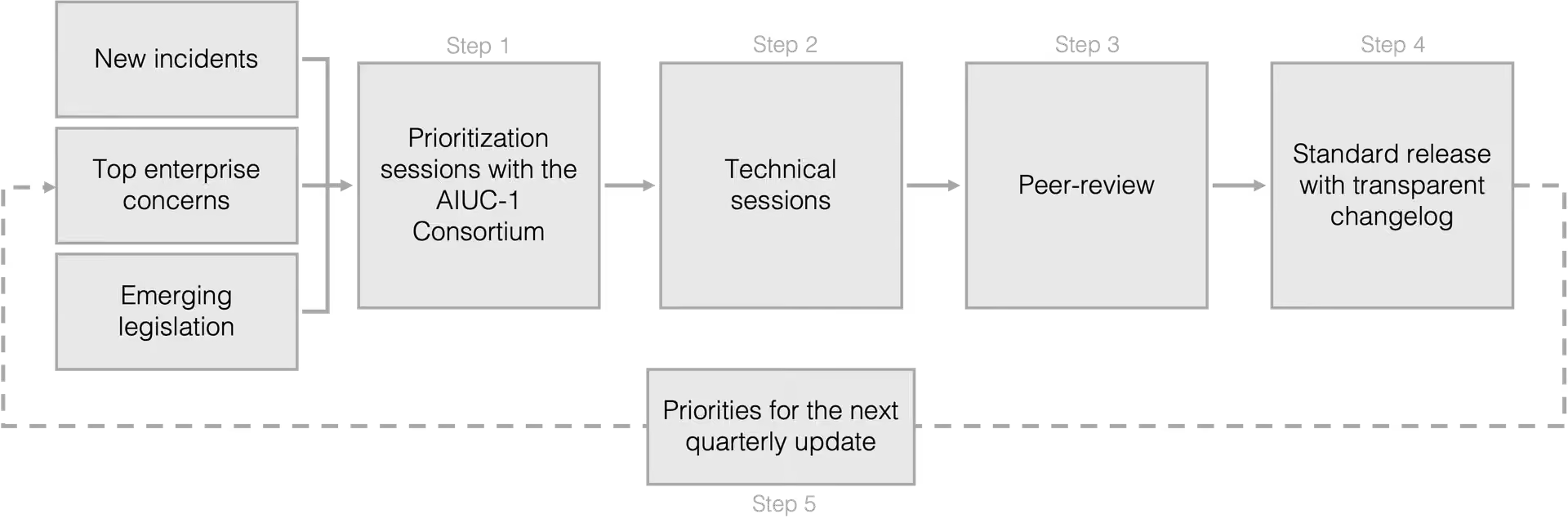
AIUC-1 is updated each quarter on January 15, April 15, July 15 and October 15 to ensure that the standard evolves as technology, risk, and regulation evolves. Quarterly updates follow a documented process involving:- Prioritization sessions with executive consortium members
- Technical working sessions with consortium members & technical contributors
- Peer-review of all standard changes
- Transparent change management with public line-by-line changelog
Tenets guiding standard updates
AIUC-1 is designed to be:- Adoption-focused. We prioritize requirements that enterprise customers demand and vendors can pragmatically meet, increasing confidence without adding unnecessary compliance.
- AI-focused. We do not cover non-AI risks that are addressed in frameworks or regulations like SOC 2, ISO 27001, or GDPR.
- Insurance-enabling. We prioritize risks that lead to direct harms and financial losses.
- Adapting to regulation. We update AIUC-1 to make it easier to comply with new regulations.
- Adapting to AI progress. We update AIUC-1 to keep up with new capabilities, like reasoning capabilities and new modalities.
- Adapting to the threat landscape. We update AIUC-1 in response to real-world incidents.
- Continuously improving. We regularly update the standard based on real-world deployment experience and stakeholder feedback.
- Predictable. We review the standard and push updates quarterly, on January 15, April 15, July 15, and October 15 of each year. Certifications remain valid for the full year, with the standard version locked at certification.
- Transparent. We keep a public changelog and share our lessons.